

When interest rates rise, most of the discussion is about mortgage repayments and what buyers can afford.
I spend a lot of time thinking about the other side. What happens to the cost of delivering the next apartment?
Developers borrow to buy land and fund construction. Higher interest costs add to the bill while the project moves through planning, construction and settlement. Delays make that bill larger. The RBA has acknowledged this pressure on new housing supply.
That leaves us with a difficult problem. Higher rates can weaken demand while also making it harder to build the homes we need.
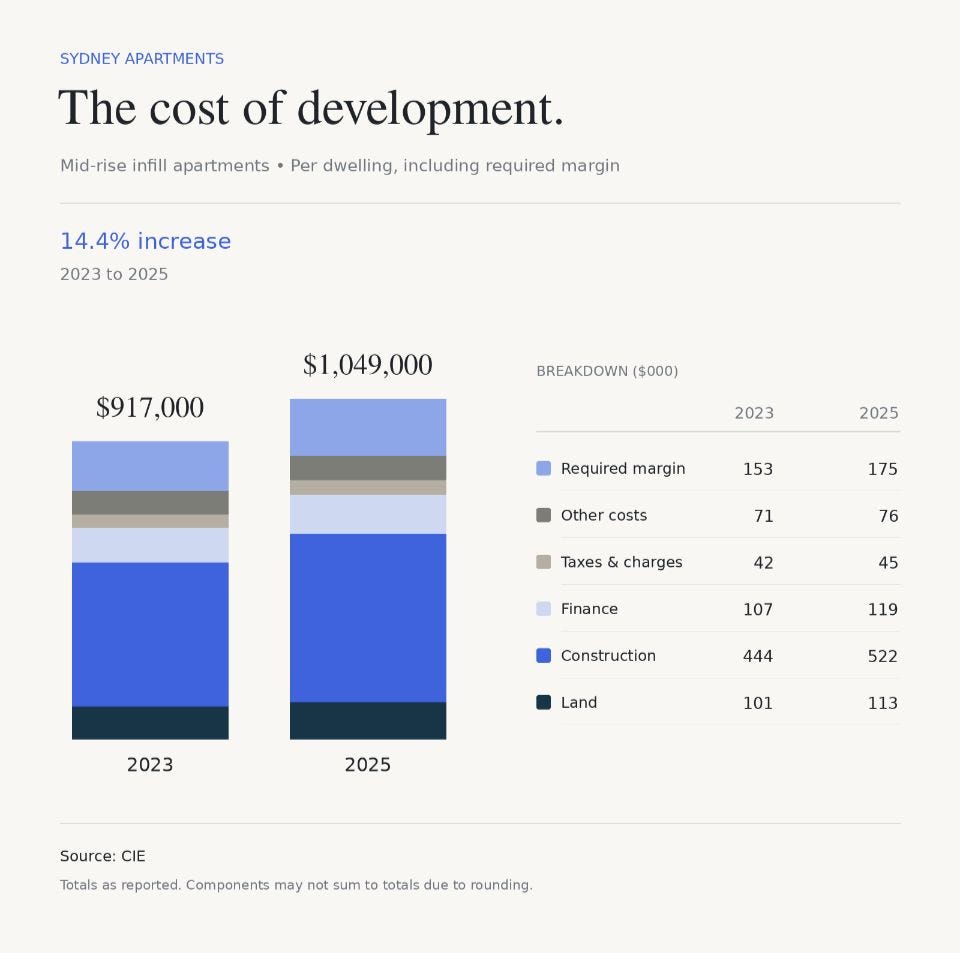
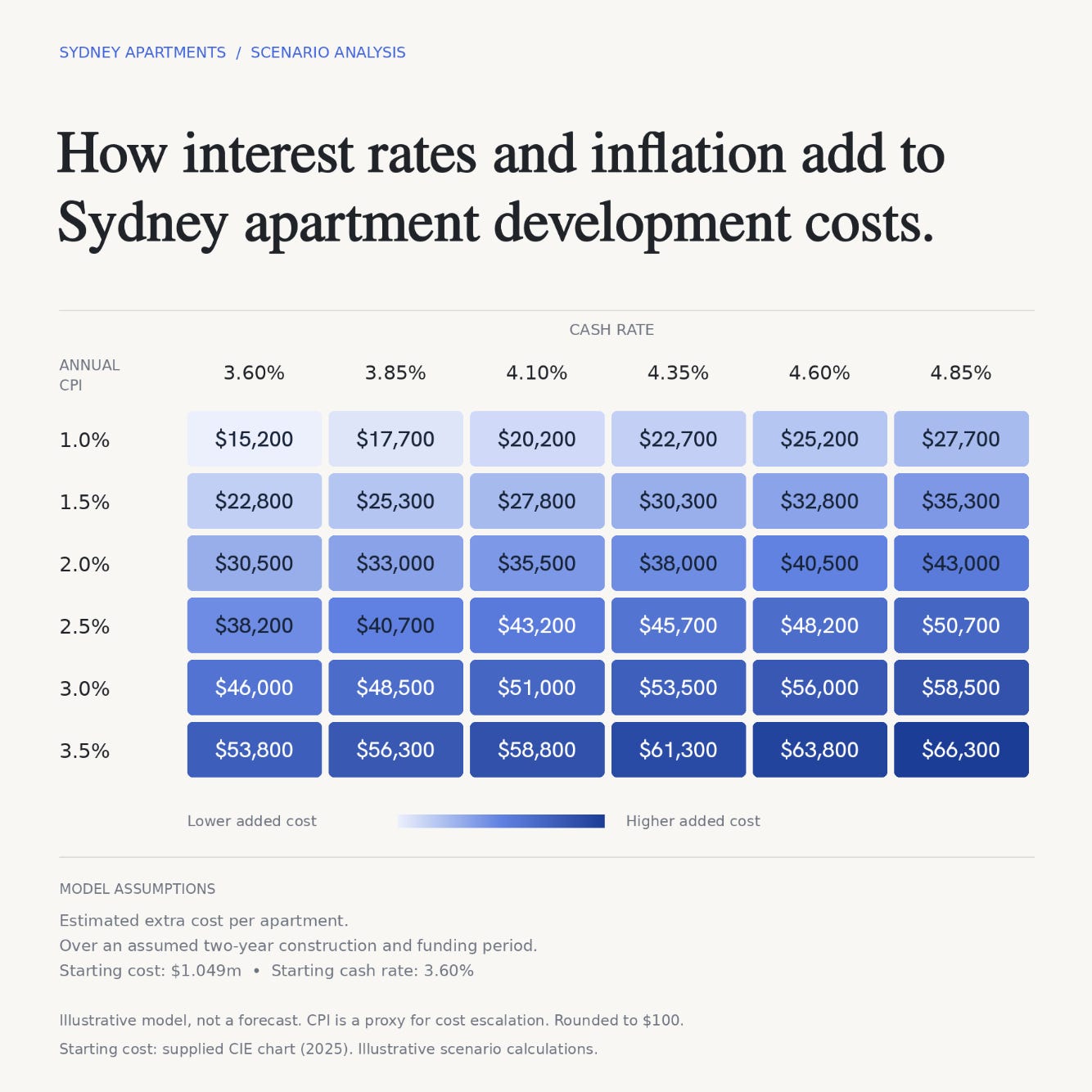
Our latest Sydney apartment development cost chart looks at this through a simple scenario model. It starts with an assumed cost of $1.049 million per apartment and tests the extra cost from different interest rate and inflation settings over two years.
It is an illustration, not a forecast. CPI is used as a proxy for cost escalation, and actual projects will differ. But it shows how sensitive the numbers can be when a large amount of capital is tied up for a long time.
A project that looked viable when the site was bought may look very different by the time the developer is ready to build. The costs have moved. The price buyers are willing or able to pay may not have moved with them.
This is part of why I’m interested in completed apartments.
They already exist. You can walk through them, inspect the finish, assess the location and compare them with what else is available. Much of the uncertainty involved in delivering a new building has passed, although defects, settlement and sales risks still matter.
That does not mean every unsold apartment is cheap. Nor does a higher replacement cost guarantee a higher sale price. Buyers still have budgets, and some stock remains unsold because the price or product is wrong.
But I think the cost of delivering competing supply deserves more attention when assessing completed stock.
For the developer, there is also a practical decision to make. Sell now and release capital, or refinance and allow more time for the remaining apartments to sell?
Waiting has a cost. Interest, outgoings and selling expenses continue. Capital stays tied up. Sometimes accepting a lower price and moving on is the better commercial decision.
In other cases, a suitable residual stock facility may give a developer room to sell at a measured pace. The numbers need to support that decision, including what happens if sales take longer than expected.
This is the work we are building around at 13x. My experience across Wealthi and Flexdoc has shaped how I look at it. Funding matters, but so does understanding the buyer and the path to a sale.